
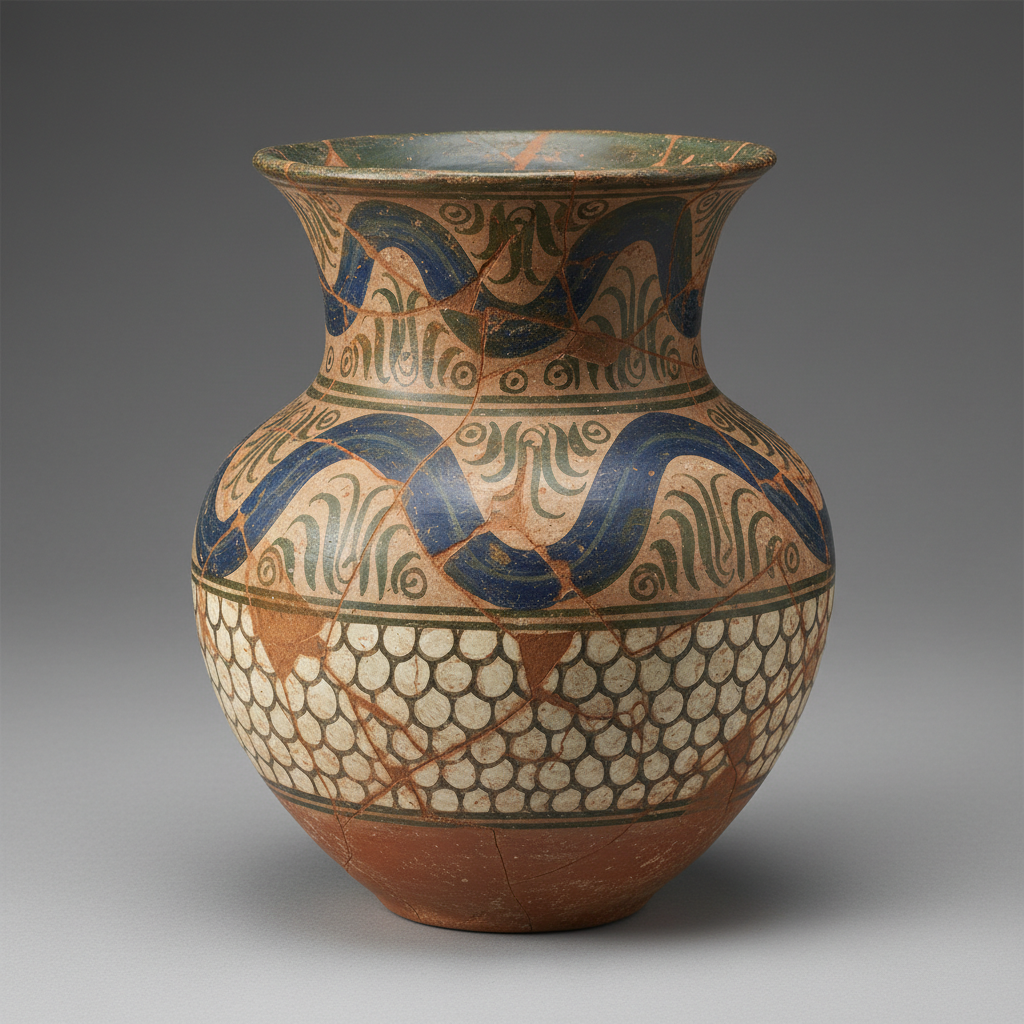
Physical Details
- Type
- pottery
- Material
- river clay, mineral pigments
- Era
- 3000 BCE
- Condition
- Fragmentary
- Dimensions
- 28cm H × 18cm W × 18cm D
- Weight
- 1200g
- Catalog #
- APO-2026-00005
commonAPO-2026-00005
River Spirit Offering Vessel
This offering vessel was placed at the river's edge as a gift to the water spirits. The seeds and petals inside would have been set adrift in a leaf-boat — a practice described in oral traditions that survived into the Kethari period.
Ritual Inscription (Oral Tradition)
Vo va te wi le mu va ve ni ra hoi
/vo va te wi le mu va ve ni ɾa hoi/
Translation
“River spirit, the water gives this offering from the hand of the mother; may the river flow blessed upon the children of the people.”
Interlinear Analysis(click to expand)
| Form | Gloss | POS |
|---|---|---|
| vo | spirit.river | noun |
| va | water | noun |
| te | give/offer | verb |
| wi | leaf/offering | noun |
| le | hand/giving | noun |
| mu | mother/source | noun |
| va | water | noun |
| ve | flow/go | verb |
| ni | child/young | noun |
| ra | people/kin | noun |
| hoi | warm/blessed | adjective |
Script: not applicable — oral tradition; no writing system
Description
A wide-mouthed vessel decorated with flowing water-line patterns in blue and green mineral pigments on a brown clay body. The interior shows residue of seeds and flower petals. The distinctive fish-scale tessellation pattern on the lower body is characteristic of early Vorrashi pottery. Reassembled from 23 sherds.
Scholarly Analysis(click to expand)
The vessel represents the earliest known Vorrashi ceremonial pottery. The clay composition matches the Ashenmere Delta alluvial deposits. Pigment analysis identifies the blue as azurite and the green as malachite, both available from copper-bearing highland rocks. The fish-scale pattern is found on 78% of all Vorrashi pottery, making it a reliable cultural marker.
Provenance(click to expand)
- discoverer
- Dr. Helena Vasquez-Mori
- discovery date
- 2017-04-19
- condition notes
- Reconstructed from 23 sherds. Approximately 70% of original vessel recovered. Missing rim section and portions of base.
- excavation team
- Ashenmere Institute Field Team 2
- discovery location
- Riverbank shrine, Site 3, Voral tributary