
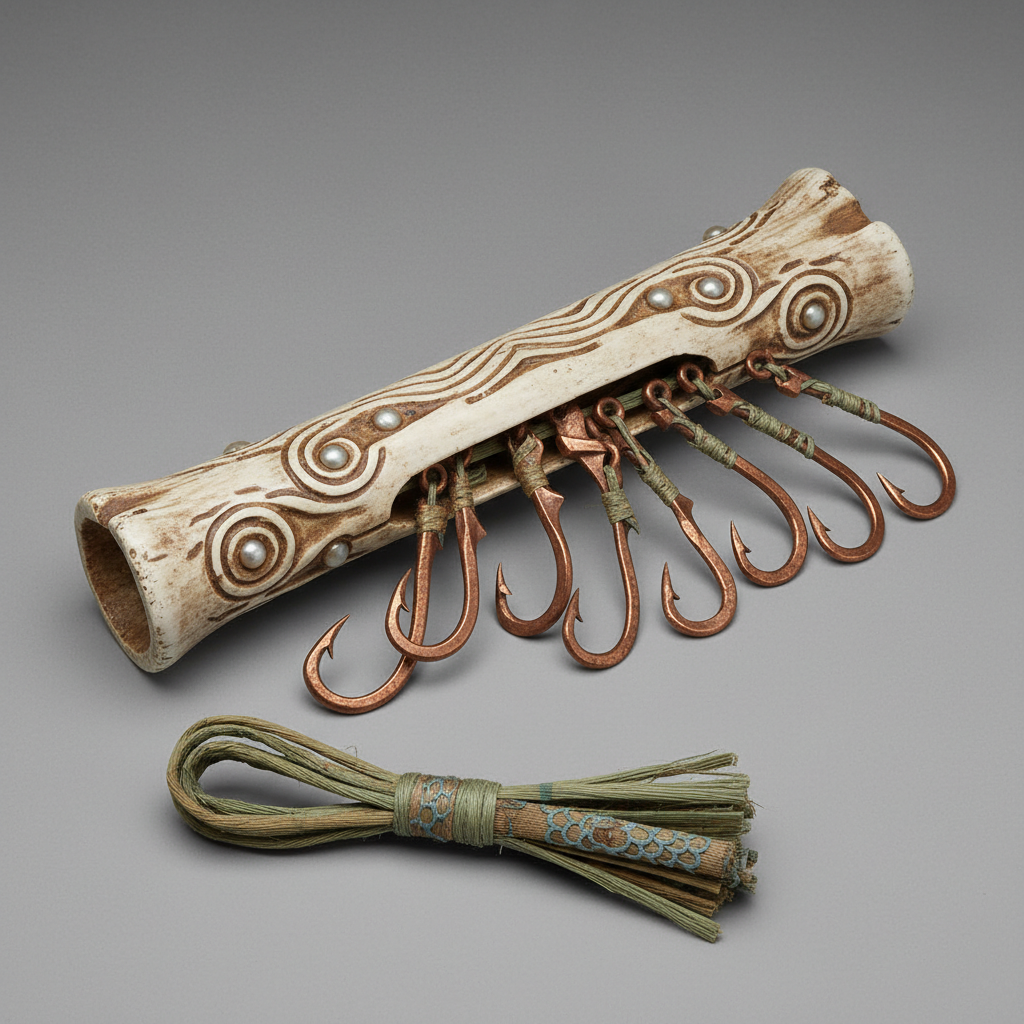
Physical Details
- Type
- tool
- Material
- hammered copper, carved bone, braided reed fiber
- Era
- 2950 BCE
- Condition
- Good condition
- Dimensions
- 12cm H × 8cm W × 3cm D
- Weight
- 95g
- Catalog #
- APO-2026-00014
notableAPO-2026-00014
Spirit-Caller's Hook and Line Set
These hooks were not merely tools — they were invitations. The Vorrashi believed fish were gifts from the river spirits, and the act of fishing was a conversation between fisher and spirit. The crushed mussel shell on each barb was the fisher's opening word.
Ritual Inscription (Oral Tradition)
Vo va te na ra we va ne he vo ve
/vo va te na ɾa we va ne he vo ve/
Translation
“The river spirit gives fish to the people, yet the river does not see the spirit flow.”
Interlinear Analysis(click to expand)
| Form | Gloss | POS |
|---|---|---|
| vo | spirit | noun |
| va | water/river | noun |
| te | give/offer | verb |
| na | fish/river-creature | noun |
| ra | people/kin | noun |
| we | but/however | conjunction |
| va | water/river | noun |
| ne | NEG | particle |
| he | see/know | verb |
| vo | spirit | noun |
| ve | flow/move | verb |
Script: not applicable — oral tradition (no writing system)
Description
A set of seven graduated copper fish hooks stored in a carved bone case decorated with the pearl-in-spiral motif. Each hook is a different size, hammered from a single copper nugget with no evidence of casting or smelting. The bone case is carved from a river mammal femur and sealed with a reed-fiber stopper. Residue analysis found traces of crushed freshwater mussel shell on the hook barbs — likely used as bait or as a ritual offering to river spirits before fishing.
Scholarly Analysis(click to expand)
The seven-hook graduation matches the seven-pearl pattern found in Great Mother burials, suggesting a numerical or cosmological significance to the number seven in Vorrashi culture. The hammered copper technique — cold-working without smelting — is characteristic of pre-metallurgical copper use. Dr. Tanaka-Reeves notes the hook sizes correspond exactly to the dominant fish species at different river depths, indicating sophisticated ecological knowledge. The bone case species has been identified as Ashenmere river otter.
Provenance(click to expand)
- discoverer
- Graduate student James Whitehorse
- discovery date
- 2023-09-20
- condition notes
- All seven hooks present and intact. Bone case cracked longitudinally but stable. Reed stopper partially deteriorated. Hooks show use-wear consistent with active fishing.
- excavation team
- Pacific Institute Field Survey
- discovery location
- Riverbank dwelling floor, Site 5, Ashenmere tributary