
Physical Details
- Type
- architecture
- Material
- volcanic basalt, iron plate, lead inlay
- Era
- 750 BCE
- Condition
- Good condition
- Dimensions
- 120cm H × 40cm W × 40cm D
- Weight
- 98000g
- Catalog #
- APO-2026-00015
Iron League-Stone of the Northern Highway
Inscription
Ferkum vikus strukat legus fortum. Krexus deviktat noxus. Serat kremat belum et honorus markat.
/feɾkum vikus stɾukat legus foɾtum noksus deviktat kɾeksus seɾat kɾemat belum et honoɾus maɾkat/
Translation
“The iron road the strong legion builds. The king conquers darkness. Serath burns war, and honor marches.”
Interlinear Analysis(click to expand)
| Form | Gloss | POS |
|---|---|---|
| ferkum | iron-ATR | adjective |
| vikus | road-NOM | noun |
| strukat | build-3SG.PRES | verb |
| legus | legion-NOM | noun |
| fortum | strong-ATR | adjective |
| krexus | king-NOM | noun |
| deviktat | conquer-3SG.PRES | verb |
| noxus | darkness-NOM | noun |
| serat | volcano/god-NOM | noun |
| kremat | burn-3SG.PRES | verb |
| belum | war-ACC | noun |
| et | and-CONJ | conjunction |
| honorus | honor-NOM | noun |
| markat | march-3SG.PRES | verb |
Description
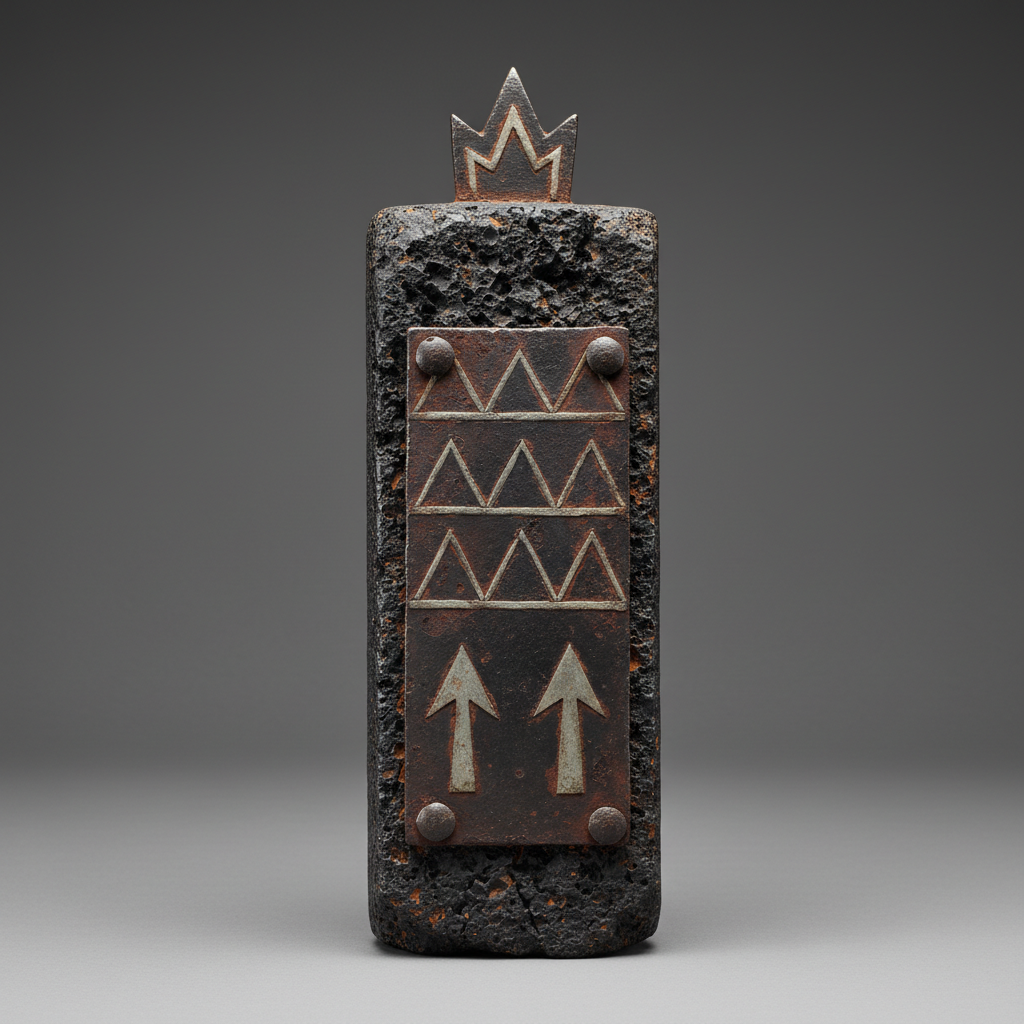
A dressed basalt pillar with an iron plate bolted to one face, bearing distance markers to three provincial capitals in the Ascendancy alphabetic script. The top is carved into the single-flame symbol. Lead-inlaid directional arrows point along the road axis. The base shows socket holes where the stone was anchored into a prepared road foundation. One of a network of league-stones placed at regular intervals along the Ascendancy highway system.
Scholarly Analysis(click to expand)
Provenance(click to expand)
- discoverer
- Professor Kwame Asante
- discovery date
- 2024-09-30
- condition notes
- Iron plate heavily oxidized but legible under X-ray. Basalt pillar intact. Lead inlay partially degraded. Base socket holes preserve original mortar.
- excavation team
- Royal Archaeological Society Field Team
- discovery location
- Road Station 12, Northern Highway, in situ