
Physical Details
- Type
- tablet
- Material
- volcanic stone, iron oxide pigment, gold leaf
- Era
- 950 BCE
- Condition
- Fair condition
- Dimensions
- 85cm H × 55cm W × 12cm D
- Weight
- 42000g
- Catalog #
- APO-2026-00016
The Ash-King's Triumph Stele
Inscription
Krexus kremum deviktat noxus et belat legus ferkum. Serat flam kremat-vi servus. Krexus strukat fortis et thuris ashum. Honorus ferkus et flam.
/kɾeksus kɾemum deviktat noksus et belat legus feɾkum. seɾat flam kɾemat.vi seɾvus. kɾeksus stɾukat foɾtis et θuɾis aʃum. honoɾus feɾkus et flam/
Translation
“The burning King conquers the darkness and the iron legion wages war. Serath's flame has burned the conquered. The King builds the fortress and the ashen stone. Glory in iron and the Flame.”
Interlinear Analysis(click to expand)
| Form | Gloss | POS |
|---|---|---|
| Krexus | king-NOM | noun |
| kremum | burning-ATT | adjective |
| deviktat | conquer-3SG.PRES | verb |
| noxus | darkness-NOM | noun |
| et | and | conjunction |
| belat | wage.war-3SG.PRES | verb |
| legus | legion-NOM | noun |
| ferkum | iron-ATT | adjective |
| Serat | volcano/god-NOM | noun |
| flam | flame-NOM | noun |
| kremat-vi | burn-3SG-PERF | verb |
| servus | servant/conquered-NOM | noun |
| Krexus | king-NOM | noun |
| strukat | build-3SG.PRES | verb |
| fortis | fortress-NOM | noun |
| et | and | conjunction |
| thuris | stone-NOM | noun |
| ashum | ashen-ATT | adjective |
| honorus | honor-NOM | noun |
| ferkus | iron-NOM | noun |
| et | and | conjunction |
| flam | flame-NOM | noun |
Description
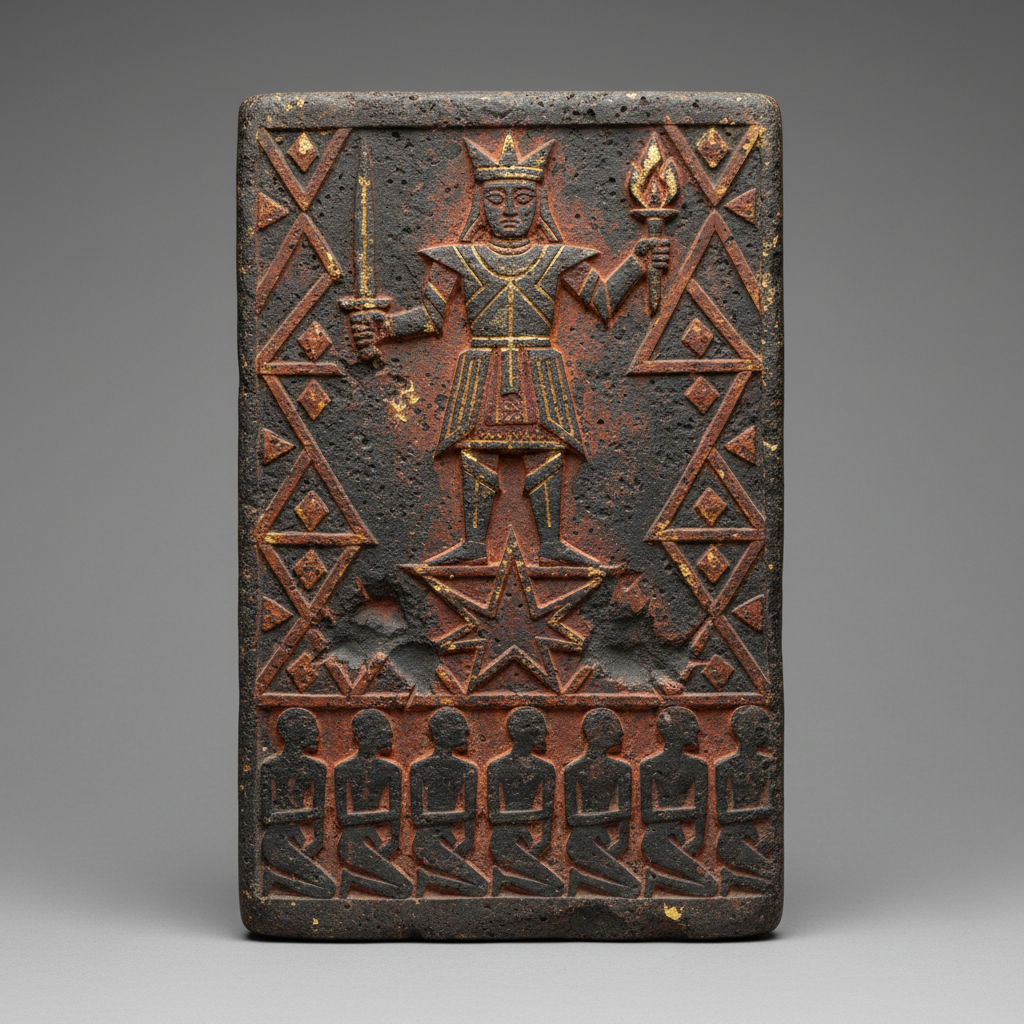
A large volcanic stone slab carved in low relief depicting the first Ash-King standing atop a crumbling seven-pointed star — a deliberate desecration of the Kethari Seven Flames symbol. The king holds an iron sword in one hand and a single flame torch in the other. Below his feet, seven kneeling figures in Kethari priestly robes offer their temple keys. The inscription in Ascendancy script proclaims: "Where seven flames flickered, one flame blazes eternal. Serath alone is god. Serath alone is king." Traces of iron oxide red and gold leaf indicate the stele was originally painted.
Scholarly Analysis(click to expand)
Provenance(click to expand)
- discoverer
- Professor Kwame Asante and Dr. Emeka Okonjo (co-discovery)
- discovery date
- 2025-01-14
- condition notes
- Upper-right corner damaged by seismic activity. Gold leaf survives in protected recesses only. Iron oxide pigment visible under UV. Three of seven kneeling figures fully intact; four partially eroded.
- excavation team
- Joint Ashenmere/Royal Archaeological Society expedition
- discovery location
- Citadel of Serath, ceremonial plaza foundation