
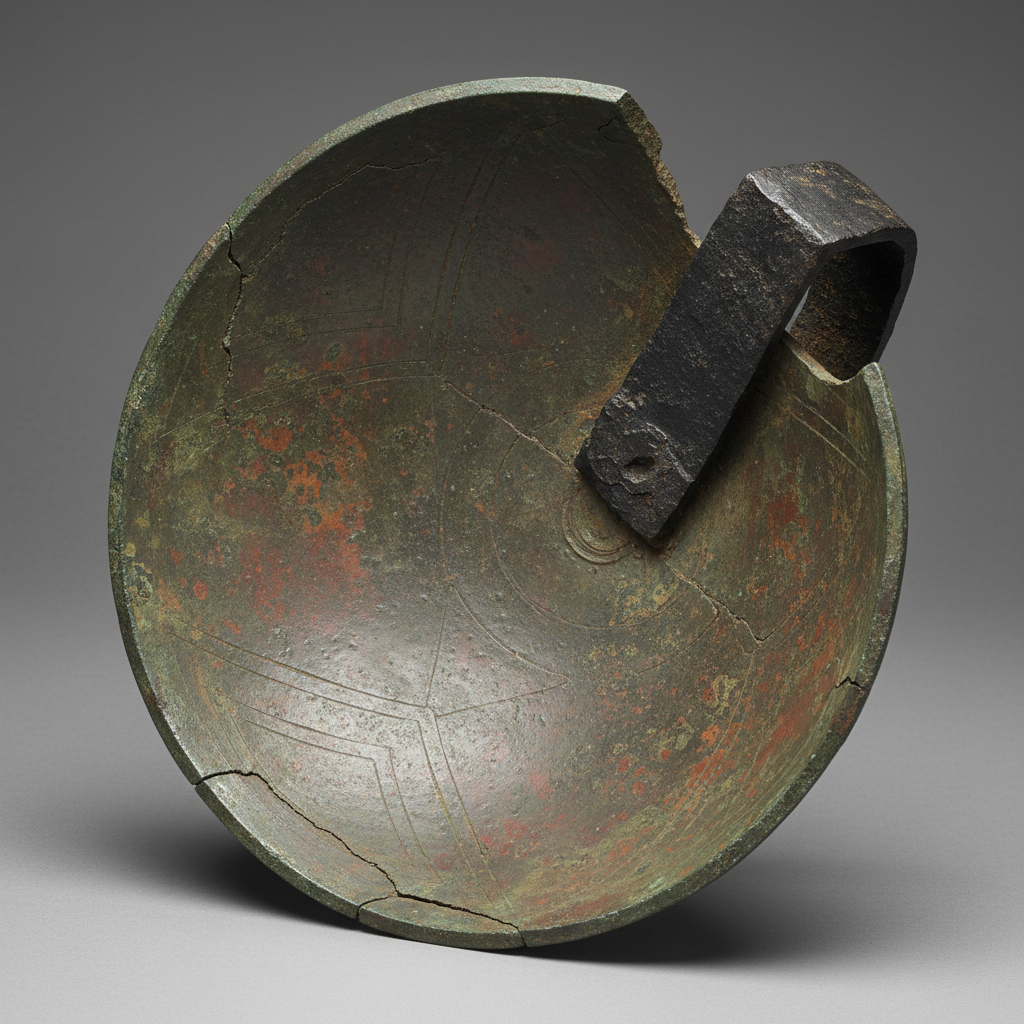
Physical Details
- Type
- tool
- Material
- bronze, iron
- Era
- 650 BCE
- Condition
- Fragmentary
- Dimensions
- 42cm H × 35cm W × 8cm D
- Weight
- 5400g
- Catalog #
- APO-2026-00020
Signal Tower Bronze Mirror Fragment
Inscription
Flam kremat noxus. Ferkus strukat fortis. Legus markat, legus deviktat. Serat kremum ashum te-at.
/flam kɾemat noksus | feɾkus stɾukat foɾtis | legus maɾkat legus deviktat | seɾat kɾemum aʃum te.at/
Translation
“The Flame burns the darkness. Iron builds the fortress. The legion marches, the legion conquers. Burning Serath gives its ash.”
Interlinear Analysis(click to expand)
| Form | Gloss | POS |
|---|---|---|
| Flam | flame.NOM — the One Flame | noun |
| kremat | burn-3SG.PRES | verb |
| noxus | darkness.NOM — enemy territory | noun |
| Ferkus | iron.NOM — the metal of conquest | noun |
| strukat | build-3SG.PRES | verb |
| fortis | fortress.NOM — stronghold | noun |
| Legus | legion.NOM — organized force | noun |
| markat | march-3SG.PRES | verb |
| legus | legion.NOM | noun |
| deviktat | de-vikt-3SG.PRES — conquers | verb |
| Serat | volcano.NOM — the divine mountain, god itself | noun |
| kremum | burn-UM — burning, zealous | adjective |
| ashum | ash-UM.ACC — the remnant of the divine fire | noun |
| te-at | give-3SG — gives [you] | verb |
Description
A large curved bronze mirror fragment, approximately one-third of the original parabolic reflector used in the Serath Ascendancy military signal tower communication system. The concave surface is still partially reflective despite centuries of burial. An iron mounting bracket is riveted to the back, designed to pivot on a tower-mounted axle. The edge shows a clean break along a stress fracture, likely from the tower's collapse.
Scholarly Analysis(click to expand)
Provenance(click to expand)
- discoverer
- Professor Kwame Asante
- discovery date
- 2025-08-10
- condition notes
- Broken into three large fragments — this is the largest and best-preserved. Concave surface retains approx 40% reflectivity. Iron bracket heavily corroded but structurally intact. Tower collapse debris preserved the fragment from further damage.
- excavation team
- Royal Archaeological Society Field Team
- discovery location
- Signal Tower 23 ruins, Northern Highway ridgeline